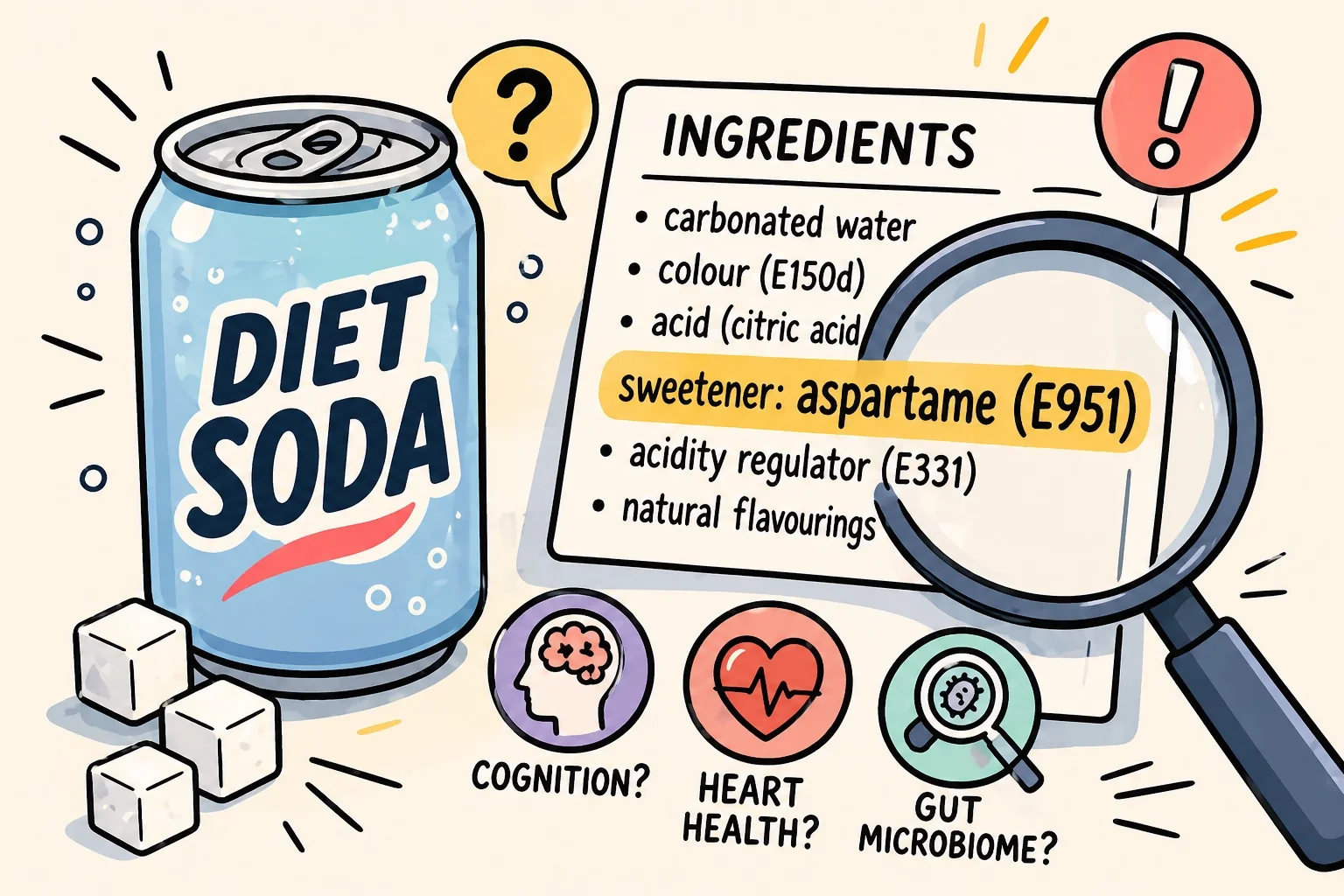
Aspartam ist einer der am besten untersuchten Lebensmittelzusatzstoffe der Welt — und zugleich einer der am meisten umstrittenen. Es steckt in rund 6.000 Produkten weltweit — Light-Limonaden, zuckerfreie Joghurts, Kaugummi, kalorienarme Desserts, sogar manche Medikamente — und alle paar Jahre erscheint eine neue Studie, die die Frage neu aufwirft: Ist dieser Stoff eigentlich unbedenklich?
Die vergangenen 18 Monate haben mehr solcher Studien hervorgebracht als üblich. Hier erfährst du also, was sie tatsächlich ergaben, was die Behörden derzeit sagen und wie man darüber nachdenken kann, ohne in Panik zu geraten oder es achselzuckend abzutun.
Was ist Aspartam, und wo findest du es?
Aspartam ist ein künstlicher Süßstoff, etwa 200-mal süßer als Haushaltszucker, vertrieben unter Markennamen wie NutraSweet und Equal und auf europäischen Verpackungen als E951 gekennzeichnet. Es wurde 1994 in der EU zugelassen und ist in rund 90 Produktkategorien erlaubt.
Die Orte, an denen du es am häufigsten siehst:
- Light- und „Zero“-Limonaden (Coca-Cola Zero, Pepsi Max, Light-Tonics)
- Zuckerfreier Kaugummi
- Light- oder „0 %“-Joghurts und Quark
- Zuckerfreie Desserts, Götterspeisen und Eiscremes
- Kalorienarme Sirupe und Fruchtsaftgetränke
- Tafelsüßstoffe (Canderel besteht großteils aus Aspartam)
- Manche Kauvitamine und Medikamente
Da Aspartam Phenylalanin enthält, schreibt die EU-Kennzeichnung vor, dass jedes Produkt, das es enthält, den Hinweis „enthält eine Phenylalaninquelle“ trägt — wichtig für Menschen mit der Erbkrankheit PKU, die es nicht verstoffwechseln können.
Was sagen die Behörden 2026 zu Aspartam?
Die EFSA (die Europäische Behörde für Lebensmittelsicherheit) hält Aspartam derzeit innerhalb einer zulässigen täglichen Aufnahmemenge von 40 mg pro kg Körpergewicht und Tag für sicher. Für einen 70-Kilo-Erwachsenen sind das rund 2.800 mg — entspricht etwa 14 Dosen Light-Cola an einem einzigen Tag. Die EFSA führte 2013 ihre letzte vollständige Neubewertung durch und kam zu dem Schluss, dass die bestehenden Grenzwerte schützend sind.
Weltweit ist das Bild etwas komplizierter. Im Juli 2023 stufte die Internationale Agentur für Krebsforschung (IARC) der WHO Aspartam als „möglicherweise krebserregend für den Menschen“ (Gruppe 2B) ein — dieselbe Kategorie wie Aloe-vera-Extrakt und eingelegtes Gemüse. Zur gleichen Zeit prüfte ein anderes WHO-Gremium (JECFA) dieselben Daten und kam zu dem Schluss, dass die bestehende ADI nicht geändert werden müsse. Die beiden Mitteilungen kamen am selben Tag und stifteten erwartungsgemäß Verwirrung.
Die Kurzfassung: Die offizielle EU-Position ist, dass Aspartam bei den aktuellen Aufnahmemengen sicher ist. Die Einstufung „möglicherweise krebserregend“ bedeutet, dass die Belege für einen Krebszusammenhang begrenzt, aber nicht null sind — ein echter Unterschied, den man eher verstehen als abtun sollte.
Was ergab die neue Forschung 2025-2026?
Drei Studien im Besonderen haben die Debatte neu eröffnet.
1. Die Neurology-Kohorte (September 2025)
Eine prospektive Studie mit mehr als 12.700 Erwachsenen, veröffentlicht in Neurology, begleitete die Teilnehmer acht Jahre lang und untersuchte die Aufnahme kalorienarmer und kalorienfreier Süßstoffe im Verhältnis zu Raten kognitiven Abbaus. Ein höherer Konsum war mit einem schnelleren Abbau in standardisierten kognitiven Tests verbunden, wobei der Effekt bei Erwachsenen unter 60 Jahren und bei Menschen mit Diabetes am ausgeprägtesten war. Aspartam war der meistkonsumierte Süßstoff in der Kohorte.
Das ist Beobachtungsforschung — sie zeigt einen Zusammenhang, keinen Beweis für eine Ursache. Aber die Kohorte war groß, der Beobachtungszeitraum lang, und die Forscher kontrollierten die offensichtlichen Störfaktoren (Alter, Bildung, Ernährungsqualität, BMI, Diabetesstatus).
2. Die Mausstudie zu Aspartam und Herz (Januar 2026)
Veröffentlicht in Biomedicine & Pharmacotherapy, verabreichte diese Studie Mäusen das Äquivalent von etwa einem Sechstel der für den Menschen empfohlenen maximalen Tagesaufnahme — deutlich unter der regulatorischen Obergrenze — und beobachtete eine leichte Herzhypertrophie (abnorme Verdickung des Herzmuskels) sowie Anzeichen einer nachlassenden kognitiven Leistung. Das Körperfett sank um rund 20 %, doch die kardialen und neurologischen Effekte traten bei Dosen auf, die die Behörden derzeit für sicher halten.
Die Autoren empfahlen ausdrücklich eine Neubewertung der Sicherheitsgrenzwerte für den Menschen. Wichtiger Vorbehalt: Es handelt sich um eine Mausstudie, und die Übertragung von Maus auf Mensch ist nicht einfach. Aber es ist die Dosishöhe, die Aufmerksamkeit erregt.
3. Die NutriNet-Santé-Ergebnisse zum Herz-Kreislauf-System
Die französische Kohorte NutriNet-Santé (dieselbe große Studie, die die Emulgator-Ergebnisse hervorbrachte) berichtete, dass der Aspartamkonsum mit einem erhöhten Schlaganfallrisiko verbunden war, während zwei andere künstliche Süßstoffe — Acesulfam-K und Sucralose — mit einem höheren Risiko für koronare Herzkrankheit verbunden waren. Die Kohorte umfasste über 100.000 Erwachsene, die im Schnitt neun Jahre lang begleitet wurden.
Auch hier: Beobachtung. Aber es ist nun der größte menschliche Datensatz zu dieser Frage, und das Signal ist über die Herz-Kreislauf-Endpunkte hinweg konsistent.
Ist Aspartam also tatsächlich gefährlich?
Ehrliche Antwort: Niemand kann dir ein klares Ja oder Nein geben, und du solltest jedem misstrauen, der es versucht.
Was gut belegt ist:
- Für die meisten Menschen in üblichen Mengen haben die Regulierungsbehörden, die die Gesamtheit der Belege geprüft haben — EFSA, JECFA, FDA —, ihre Position nicht geändert.
- Für Menschen mit PKU ist Aspartam tatsächlich gefährlich und wird entsprechend gekennzeichnet.
- Die Erzählung, „Light-Getränke helfen beim Abnehmen“, ist viel schwächer, als das Marketing nahelegt; aktuelle Übersichtsarbeiten sind bestenfalls gemischt.
Was wirklich unsicher ist:
- Ob ein langfristiger, regelmäßiger Konsum auf Niveaus deutlich unter der ADI Herz-Kreislauf-, kognitive oder Krebs-Folgen auf subtile Weise beeinflusst, die einzelne Kurzzeitstudien nicht erfassen würden.
- Wie Aspartam mit dem Darmmikrobiom interagiert — ein aktives Forschungsfeld mit beunruhigenden frühen Signalen.
- Ob die IARC-Einstufung „möglicherweise krebserregend“ mit zunehmenden menschlichen Daten letztlich heraufgestuft oder herabgestuft wird.
Eine vernünftige Lesart der aktuellen Belege: Gelegentlicher Gebrauch ist mit ziemlicher Sicherheit unbedenklich. Täglicher Konsum über mehrere Produkte — Light-Limo zum Frühstück, ein zuckerfreier Joghurt zum Mittag, ein „Zero“-Getränk zum Abendessen, danach zuckerfreier Kaugummi — ist heute schwerer mit Überzeugung zu verteidigen als noch vor fünf Jahren.
Und die Alternativen?
Hier bleibt das Gespräch oft stecken, denn auch die Alternativen haben Probleme.
- Zucker ist gut verstanden und sollte aus völlig anderen Gründen begrenzt werden (Zähne, Stoffwechsel; die niederländische suikertaks ab 2030 spiegelt das wider).
- Stevia (E960) ist pflanzlich gewonnen und hat ein vertretbares Sicherheitsprofil, doch die stark verarbeiteten Extrakte verhalten sich anders als das Blatt.
- Sucralose (E955) zeigt eigene aufkommende Forschungssignale rund um das Herz-Kreislauf-Risiko und mögliche DNA-Schäden bei hohen Dosen.
- Acesulfam-K (E950) taucht in vielen derselben Studien wie Aspartam auf, oft gemeinsam mit ihm.
- Erythrit (E968) war 2023 Gegenstand einer Arbeit, die es mit Herz-Kreislauf-Ereignissen in Verbindung brachte und noch diskutiert wird.
- Xylit verhält sich ähnlich — eine Studie von 2024 brachte es mit höheren Raten von Herz-Kreislauf-Ereignissen in Verbindung.
Es gibt keinen offensichtlich sauberen Wechsel. Der vertretbarste Schritt, wenn du eines dieser Produkte häufig konsumierst, ist, die Gesamtbelastung zu senken, statt zwischen ihnen zu wechseln.
Wie du prüfst, was in deinen Light-Getränken und zuckerfreien Produkten steckt
Süßstoffe sind in der Zutatenliste jedes vorverpackten Produkts, das in der EU verkauft wird, mit Namen oder E-Nummer aufgeführt. Häufige, die du kennen solltest: Aspartam (E951), Acesulfam-K (E950), Sucralose (E955), Stevia (E960), Erythrit (E968).
Schneller, als die Rückseite jeder Dose zu lesen — scanne den Barcode. Ein Lebensmittelscanner wie Nime liest die vollständige Zutatenliste, kennzeichnet, welche Süßstoffe in einem Produkt stecken, und lässt dich zwei Optionen im selben Regal in Sekunden vergleichen. Für Produkte, die du wöchentlich gedankenlos kaufst — eine bestimmte Joghurtmarke, ein Standard-Erfrischungsgetränk — ist das der einfachste Weg, tatsächlich zu sehen, was in deiner Routine steckt.
Ein paar praktische Muster, die sich im EU-Regal bewähren:
- Light- und „Zero“-Limonaden enthalten fast immer Aspartam, Acesulfam-K oder beides.
- „0 %“-, „Light“- und „zuckerfreie“ Joghurts enthalten fast immer Süßstoffe — meist Aspartam oder Acesulfam-K, zunehmend Stevia.
- „Ohne Zuckerzusatz“ bedeutet nicht „ohne Süßstoffe“ — meist bedeutet es das Gegenteil.
- Zuckerfreier Kaugummi ist eines der Produkte mit der höchsten Aspartamdichte im Regal.
Häufig gestellte Fragen
Ist Aspartam irgendwo verboten?
Kein Land hat Aspartam für den allgemeinen Gebrauch vollständig verboten. Frankreich versuchte 2015, es einzuschränken, und der Vorschlag wurde auf EU-Ebene abgelehnt. Foodwatch, Yuka und die französische Ligue contre le cancer starteten eine Petition für ein vorsorgliches EU-Verbot, die noch läuft, doch im April 2026 bleibt Aspartam EU-weit zugelassen, gemäß der bestehenden ADI der EFSA von 40 mg/kg/Tag.
Wie viel Aspartam ist zu viel?
Die zulässige tägliche Aufnahmemenge der EFSA beträgt 40 mg pro kg Körpergewicht. Für einen 70-kg-Erwachsenen entspricht das in etwa 14 Standarddosen Light-Cola pro Tag. Die meisten Menschen kommen dem nicht nahe. Die Sorge der neueren Forschung gilt nicht der akuten Toxizität — sondern der Frage, ob eine chronische, niedrigschwellige Aufnahme über Jahre Effekte hat, die die Kurzzeitstudien nicht erfasst haben.
Warum ist Aspartam als „möglicherweise krebserregend“ eingestuft, wenn es weiterhin erlaubt ist?
Die IARC-Einstufung in Gruppe 2B bedeutet, dass es begrenzte Belege für ein Krebsrisiko beim Menschen und begrenzte oder unzureichende Belege bei Tieren gibt. Es ist dieselbe Kategorie wie Aloe-vera-Extrakt, eingelegtes Gemüse und Benzinmotor-Abgase bei niedrigen Werten. Es bedeutet nicht, dass Aspartam definitiv Krebs verursacht — es bedeutet, dass ein Zusammenhang nicht ausgeschlossen werden kann und mehr Forschung nötig ist. Die Behörden haben entschieden, dass die bestehenden Aufnahmegrenzwerte in der Zwischenzeit schützend sind.
Ist Aspartam schlimmer als Zucker?
Anderes Problem, andere Antwort. Die Risiken von Zucker (Zähne, Stoffwechsel, Gewichtszunahme bei übermäßigem Konsum) sind gut belegt und auf Bevölkerungsebene groß. Die Risiken von Aspartam sind weniger sicher, doch neuere Forschung legt nahe, dass sie nicht null sind. Die vertretbarste Position ist, die Gesamtaufnahme von beidem zu senken, statt das eine dauerhaft durch das andere zu ersetzen.
Wie erkenne ich, ob ein Produkt Aspartam enthält?
Lies die Zutatenliste — es steht dort als „Aspartam“ oder „E951“. Jedes Produkt, das es enthält, muss in der EU per Gesetz auch „enthält eine Phenylalaninquelle“ ausweisen. Eine Scanner-App wie Nime kennzeichnet es (und andere Süßstoffe) automatisch, sobald du den Barcode scannst.
Quellen: EFSA-Gutachten zu Aspartam, 2013; gemeinsame Mitteilungen von IARC und JECFA, Juli 2023; Aiestaran-Zelaia et al., Biomedicine & Pharmacotherapy, Januar 2026; Neurology, Kohortenstudie vom September 2025 zu Süßstoffen und kognitivem Abbau; Ergebnisse der französischen NutriNet-Santé-Kohorte zu künstlichen Süßstoffen und Herz-Kreislauf-Erkrankungen; Petition von foodwatch, Ligue contre le cancer und Yuka.